

EXECUTION WITHOUT OPERATIONAL DRAG
Growth stalls when operational complexity outpaces structural clarity.
We redesign operating environments to ensure execution discipline, governance alignment, and measurable performance control.

Where Execution Breaks
-
Decision authority distributed across multiple leadership layers
Operational questions escalating without defined approval pathways
Execution slowing as teams wait for informal leadership intervention
-
Performance dashboards expanding across functions and initiatives
Metrics tracked without clear ownership for corrective action
Reporting activity increasing without improving operational discipline
-
Reporting systems evolving independently across teams and functions
Performance data consolidated manually across multiple sources
Leadership visibility dependent on inconsistent operational definitions
-
Automation tools introduced before workflows are stabilized
Technology amplifying existing process gaps and coordination issues
Analytics platforms generating insight without operational alignment
Across operating environments, a consistent set of structural patterns tends to emerge as organizations scale. Below are the most common execution conditions observed across engagements.
OUR OPERATING DISCIPLINE FRAMEWORK
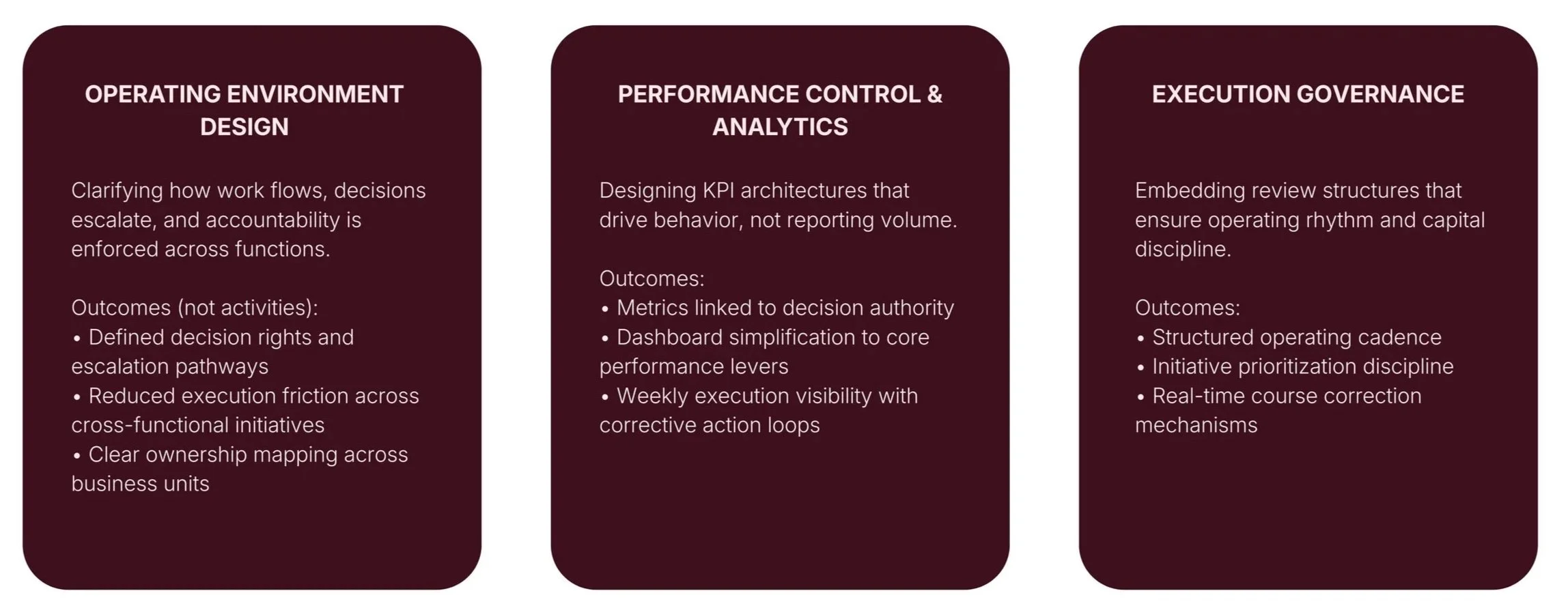
Execution Systems Implemented Across Engagements
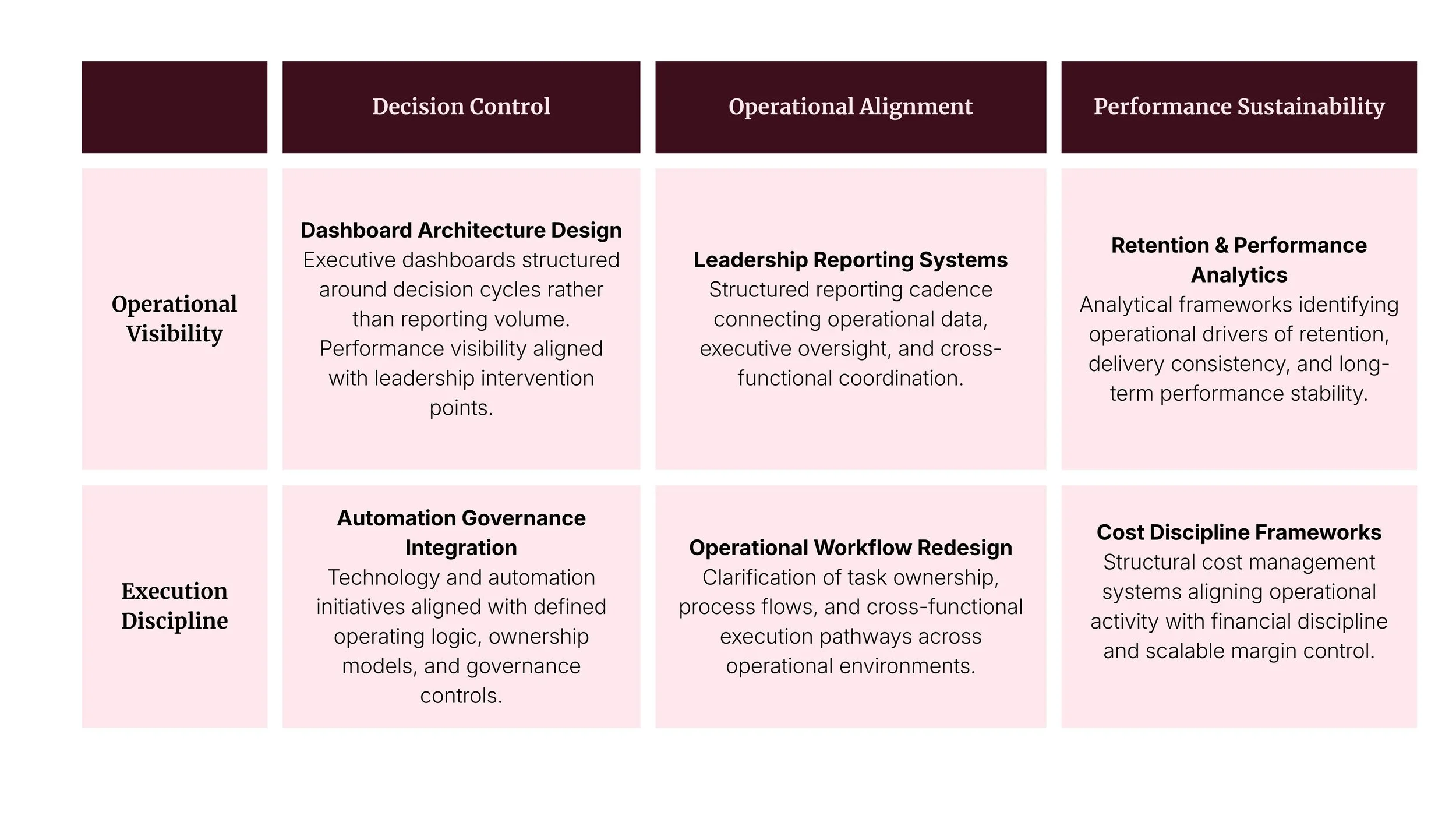
Execution reliability depends on the alignment of operational visibility and execution discipline.
The following capability layers are commonly implemented across engagements.
Selected Execution Engagements
Representative examples of operating redesign work across different environments.
-
Context
Rapid expansion across locations created coordination complexity across operations and leadership teams.
Observed Constraint
Decision escalation slowed execution cycles due to unclear ownership and fragmented reporting.
Intervention
Operational reporting redesign, decision-rights clarification, and leadership dashboard architecture.
Result
Improved operational visibility and faster execution cycles across locations.
-
Context
Customer growth increased pressure on product, support, and operational coordination.
Observed Constraint
Operational metrics existed but were disconnected from decision authority.
Intervention
Design of KPI architecture, executive dashboards, and structured operational review cadence.
Result
Improved coordination between product, commercial, and operational leadership.
-
Context
Production planning, supply coordination, and demand forecasting operating across disconnected workflows.
Observed Constraint
Limited operational visibility across production timelines, cost drivers, and delivery commitments.
Intervention
Operational workflow redesign and cost discipline frameworks integrated with reporting systems.
Result
Improved alignment between production planning, logistics, and financial performance.
Operational Diagnostics
Operational strain often appears gradually as organizations scale through slower decisions, fragmented reporting, or unclear ownership across teams.
In many cases, these are signals that the operating environment requires structural adjustment.
An operational diagnostic helps identify the structural constraints affecting execution and clarifies where operating systems, reporting, or governance require redesign.
Diagnostic sessions available for leadership teams evaluating operational improvement.